Q + A Jack Berry
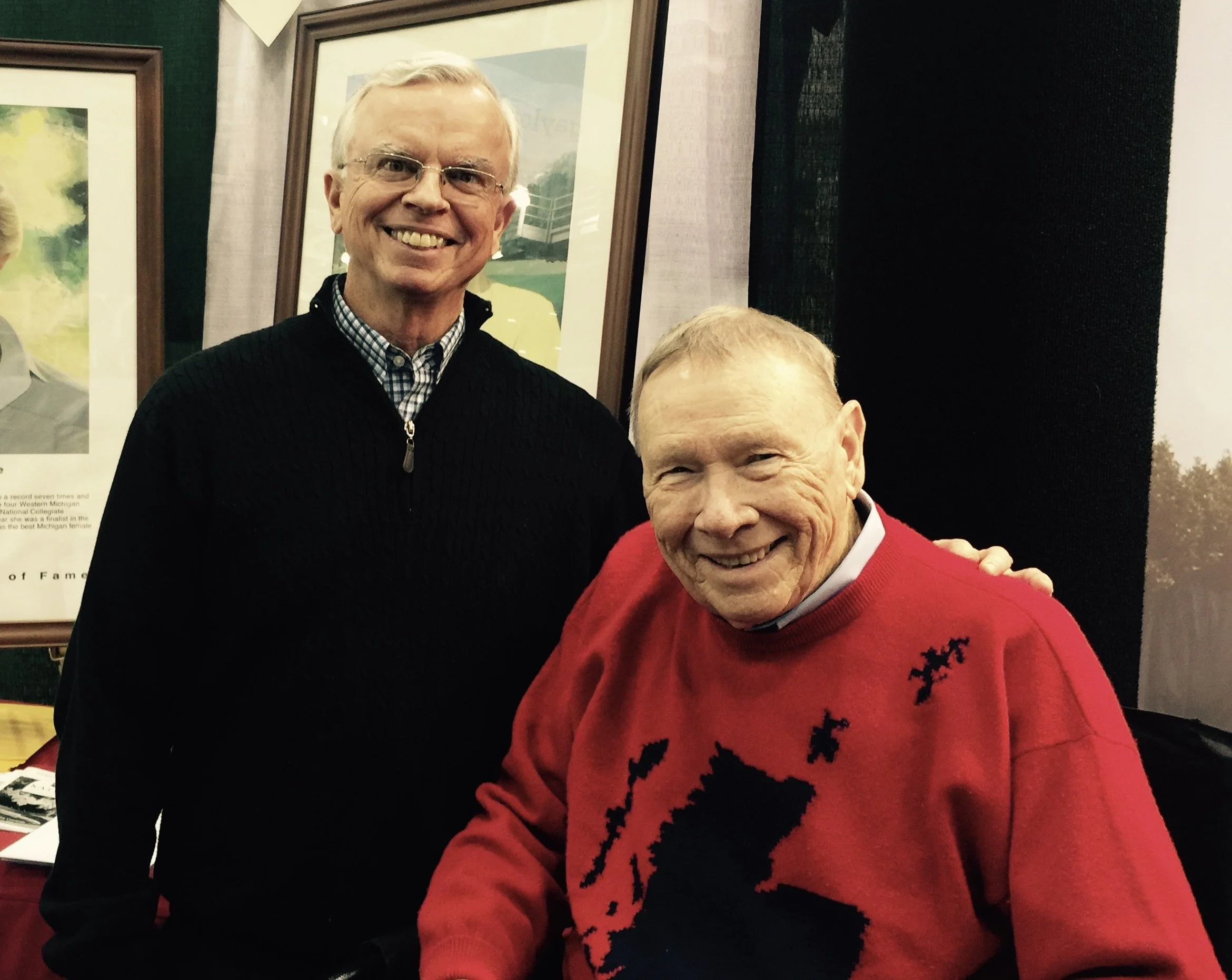
Terry Moore and Jack Berry
Even before I became the founding editor of the Michigan Golfer in 1982, I knew the name of Jack Berry. His by-line in the Detroit Free Press and later in The Detroit News was the one I sought out in my morning newspaper routine. If you wanted to know about golf in Michigan, you read Jack Berry. He was the man before the man. Later when I nervously took the editorial reins of Michigan Golfer, I told the publisher—my friend and business partner Art McCafferty—we had to secure Berry as a regular contributor. Fortunately, after a cordial and disarming lunch meeting with Art and me, Jack agreed to be regular and not overly compensated lead columnist. I still recall leaving the restaurant and saying to Art, “We’ll be alright. Jack Berry’s with us.”
In those early days, the magazine made a little name for itself for doing several high profile and exclusive interviews with such prominent names as former President Gerald R. Ford, Tom Watson and Ken Venturi. In 1984, I also conducted an interview with Berry when he was the President of the Golf Writers Association of America, a prestigious organization where he later served for nine years as its Secretary-Treasurer. 30 years later, I’ve finally gotten around to a follow up interview. Please excuse my procrastination! Over that time span, Berry has continued to cover golf—for a variety of media outlets, including internet TV—with passion, accuracy and keen insight. Along the way, the Michigan Golf Hall of Fame member has received a number of well-earned national awards including the PGA of America’s Lifetime Journalism Award and the Masters Major Achievement Award—which included as a perk a reserved Media parking spot!—for covering more than 40 Masters tournaments. On a personal note, I’ve been enriched by his friendship, company, humor and counsel. I’m still muttering, “We’ll be alright. Jack Berry’s with us.” —Terry Moore
Being a voracious reader, share some of your golf reading habits.
Even though print has changed dramatically, I still read and follow Golf Digest, Golf Magazine, Golfweek and SI Golf Plus. As far as national writers, I admire Jaime Diaz, Tim Rosaforte, Brian Hewitt, John Garrity, Jeff Rude, Jim McCabe and Karen Crouse, to mention a few names. Of course, Doug Ferguson of the Associated Press does a great job. He’s in that select and rare company that covers golf, mainly the PGA Tour, on a full-time basis. Very few people do that anymore.
What do you look for and admire in good golf writing?
I like golf writers with a light touch. There are a number of writers who have a gift for a strong lede and know how to maintain a clever voice while telling a good story. I also look for the score! (Laughing.) Even today, you’ll see some established writers omitting the player’s or the tournament score. I must confess it happened to me a few times when I used to cover the Detroit Red Wings. Yep, I occasionally left out the final score in my game story. Then I either caught it at the last moment or the copy desk bailed me out. But in general, a good story gets back to the five W’s: who, what, when, where and why.
Talk about the work and craft of sportswriting.
To write well is hard work. And you have to ask a lot of good questions. Then you take those answers and turn them into an interesting story or article. For example, I was proud of the Detroit Free Press story about the guy who walked 21 miles a day and took several buses to get to and from work. It became a national sensation.
To be able to write a story about such a hard-working person, someone not complaining or asking for any special favors was very impressive. It’s the essence of good in-depth newspaper writing.
And what about your non-golf reading favorites?
Well, I love reading the novels and short stories of Jim Harrison, a Michigan native who attended Michigan State, my alma mater. Before moving to Arizona and Montana, he spent a number of years in northern Michigan and frequently writes about it and the Upper Peninsula. He’s fun to read and has a great take on life and circumstances. I particularly enjoyed The English Major.
Is the game of golf really in trouble or has its woes been overstated? Recently the USGA President made the observation that although golf’s participation is not growing, the only two sports that are showing any growth are lacrosse and soccer. What’s your take?
I share the opinion that’s it’s been overstated. I’m really impressed with such initiatives as the Drive, Chip & Putt Championship and the PGA Junior Golf League. Both are growing like crazy. There’s definitely cultural and social factors going on—such as time constraints for families and so many recreational choices for kids—but I don’t think golf is dead.
With the passing of Billy Casper, what are your memories of him and his 1958 Buick Open victory at Warwick Hills?
I remember in ‘58 Palmer (Arnold) shot a course record 67 in the second round and then a big storm hit that prevented the rest of the field from finishing. In those days, the Tour just washed out all the posted scores and started over the next day from scratch. It was a bad break for Palmer and good one for Casper as he went on to win the tournament. Speaking of Casper, I had the chance to see David Feherty’s re-airing of his Casper interview and it was excellent. Casper was just terrific in it.
From your early days with the Detroit Free Press, talk about one of your first encounters with Ben Hogan.
Billy Casper once described Ben Hogan as having an “abrupt personality.” I’d say, tell me about it! At the 1961 U.S. Open at Oakland Hills—my first Open— I was up in the men’s locker room on Monday during tournament week along with John Walter, the longtime golf writer of The Detroit News and a few other reporters and we were chatting with Hogan. Suddenly, Hogan asked in a sharp tone, “Why wasn’t there any Open stories in the Free Press yesterday (Sunday)?” So I spoke up and said, “Well, that was my day off.” He was still in a huff about it when John came to my defense by saying, “It’s not Jack’s fault, Ben, it’s the paper’s. He wasn’t working.” I really appreciated John saying that. Nowadays there would always be a Sunday advance on a major tournament. But back then, it didn’t happen and Hogan wasn’t happy about it. Yessir, he was quite abrupt.
In Michigan, what individuals did you chat with and lean on for the latest information?
Walter Burkemo, who won the 1953 PGA, always had good stories. He was a friendly Detroiter from the east side and a fine player, particularly at match play. I also enjoyed some of the old club pros like Chet Jawor, Ray McGuire, Bill Uzelac and Warren Orlick—to mention just a few names—because they always knew what was going on. Warren was a past President of the PGA of America and became the Chairman of the PGA Rules Committee where he was usually seen at most of the majors. One time, he was working the famed island green 17th hole at the TPC Stadium Course. After a round, I asked him how many balls he saw go in the water. Warren refused to tell me because he felt the information would be embarrassing to the players. Today the networks keep a running tally of the drowned shots.
On that note, as a reporter didn’t you compile a “worst ball” score for the Michigan Open at The Bear at Grand Traverse Resort?
Yes, I took a little devilish delight in doing it. Back then, The Bear had the reputation as one of the toughest courses not only in Michigan but in the country. So I did my part by keeping and reporting on highest score recorded on each hole. One year the worst ball nines were 81-82.
And given this time of year, what about your Masters experiences?
I’ve been fortunate to have attended 43 of them. It’s the best run tournament and event not only in golf but in all of sport. Everything from the concessions to the facilities to the way people are treated are all unbeatable. And if you’re any kind of sports or golf fan at all, you know that golf course even if you haven’t been there in person. That’s the advantage of the Masters and Augusta National: it’s a part of everyone’s television history. Besides, the Masters doesn’t need loud music, dancing and fireworks to make it “an experience.”
Talk about your involvement with the Free Press Junior Golf School and some of the young players you met.
I got to know the Parrott youngsters in that school—Janina and her brothers. Their father was a great guy and a Detroit firefighter. He always called me “Mr. Berry.” And Janina Parrott Jacobs became one of the best women players in the state. I also met Joyce Kazmierski during that time. Later becoming a prominent college and LPGA player, she also served as President of the LPGA. Another junior player in the program was Ernie Harwell’s son, Gray. In fact, Gray won the boy’s championship one year.
If one of your grandchildren or somebody’s else’s ever asked you about becoming a writer or a journalist, what would say?
Well, I’d say to them that I loved it. But I’d also tell them they’d never get rich doing it. But the intrinsics far exceed the external rewards. I’ve met many great people and have visited so many beautiful places because of my career and golf. It’s been a wonderful experience. John Walter said it best about the golf beat, “You meet the nicest people and go to the nicest places.” I couldn’t agree more. And unlike some of the team sports I covered, golfers spoke in complete sentences and I didn’t have to bleep out anything.
A member of the Michigan Golf Hall of Fame, Terry Moore lives in Grand Rapids and serves as a Governor for the Golf Association of Michigan and as a Board member for the Michigan Golf Foundation.